

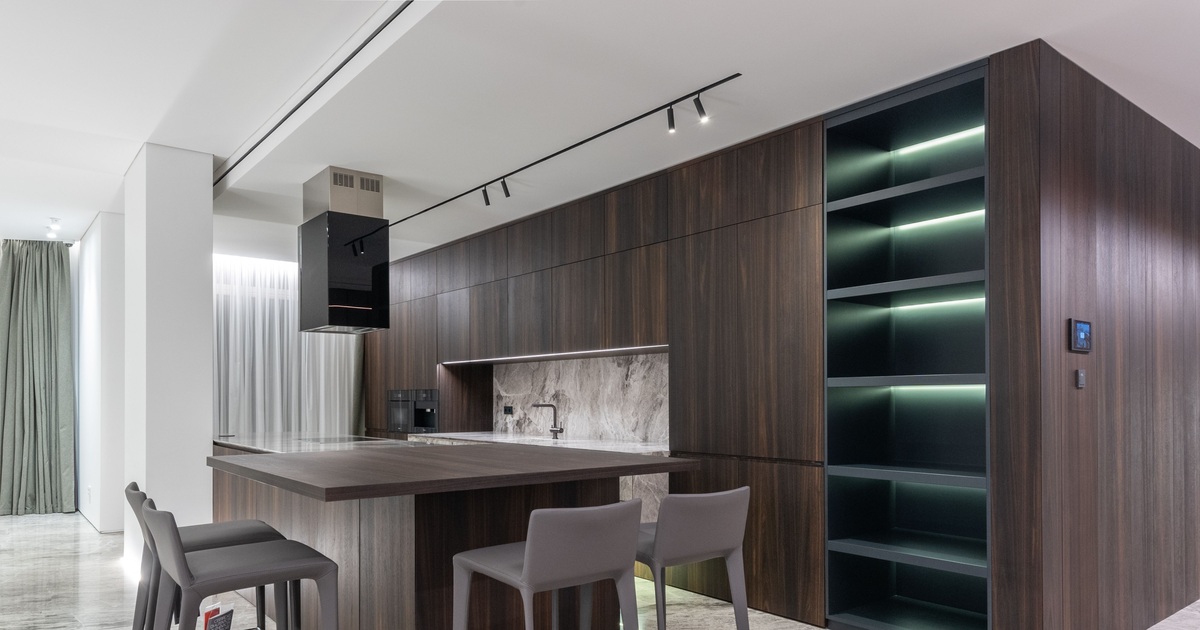
Dimmable rail lighting requires an appropriate combination of rail installation, spot, light source or driver and control system. The word ‘dimmable’ alone is not enough. First determine which lights should react together and how low you want the light to be adjusted.
Start with the desired operation
Do you want to dim all the lights at once, create separate zones, or control each light individually? Also describe the desired use: bright light for cleaning, focused light on products, or a low evening light above the table.
A rail with multiple circuits can support separate groups when the installation has been carried out accordingly. That does not automatically provide individual dimming per spot. Read The difference between 1-phase and 3-phase before you choose the scheme.
GU10 or integrated LEDs?
With a GU10 rail fixture, you choose a suitable replacement bulb. Be sure to check whether that bulb is dimmable and with which control system. The fixture must also be compatible with the bulb and the intended electrical application.
With a railspot equipped with integrated LEDs, the driver determines, among other things, which control scheme is possible. A non-dimmable version cannot be dimmed by installing a wall dimmer. Furthermore, the replaceable nature of modules varies per model; integrated does not always mean that no component can be replaced.
Which dimming method is suitable?
Phase cutting and phase splitting are controlled via the power supply, but are not interchangeable with each other for every lamp. Check the prescribed method. DALI or a wireless system requires appropriate drivers, adapters, and control units.
Read phase cutting and phase cutting off and the compatibility information for the exact lamp and dimming model. Do not connect a driver with a different control method behind a phase-controlled dimmer without proper justification.
Adding wattage is one control
Suppose six fictitious lamps consume 5 watts each. Together that is 30 watts. That does not mean that every dimmer with a range that falls within 30 watts is suitable. The permitted LED load and the supported number of lamps can introduce additional limits.
Check the manufacturer's specifications for the complete combination. The dimmer may react differently with one lamp than with six lamps. Also take into account any limitations due to mounting conditions or connected equipment. A general maximum for incandescent bulbs is not an automatic maximum for LED bulbs.
Example: rail above the table and wall cabinet
Suppose four spots illuminate the dining table and two spots illuminate a wall in the cabinet. During the meal, you want the cabinet to glow softly and the table to be adjusted separately. With a conventional dimmer circuit, all six lamps react together.
Therefore, first compare a suitable division or individual arrangement. Then test the selected lamps with the actual controls and numbers. Do all the lamps operate reliably from the low setting and remain stable when you slowly dim them?
Also check the off, on, and behavior after a while of burning. Note which lowest setting is usable. A dimmer that can be operated to zero percent does not guarantee that the light will dim back to zero visibility.
Adjustment and malfunctions are distinguished
An adjustable minimum setting can help within the product specifications to define the usable range of operation. It does not repair incorrect wiring or unsuitable drivers. Have qualified personnel investigate fixed connections and unexplained malfunctions.
Read Adjusting a dimmer for the method. When soldering after switching off is the explanation about soft persistent burning more relevant than just adjusting the lowest dimming level.
Do you want warmer light too?
Simply dimming does not necessarily change the color temperature. For a warmer color at lower light levels, you need a dimming-to-warm-function designed for that purpose. A local CCT switch is a different function and does not automatically follow the dimming mode.
Compare railspots as a complete combination with lamp and control unit. Store product codes and settings so that a replacement lamp can be checked against the same requirements later on.